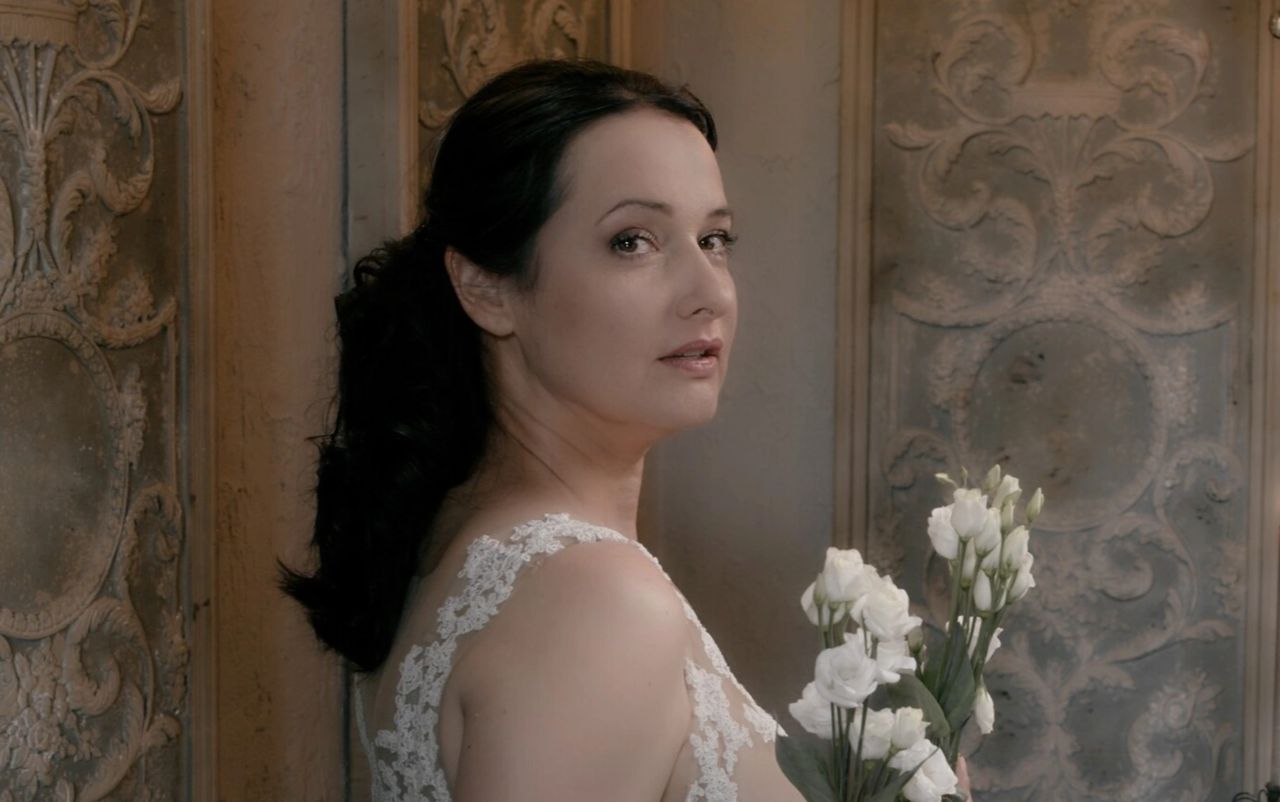
Soft Floating in the Fields of Spheres with Peter Korday – New York Macoproject Interview

Soft Floating Spheres is Peter Korday’s latest feature film, exploring silence, memory, identity and the fluidity of time.

Vision and Philosophy

You describe the film as “born from silence.” Can you elaborate on what this silence represents — artistically and personally?

The film is not based on real events — it is fiction. Yet it was inspired by deeply personal experiences, pain, and loss. As a director, the deeper I delved into Rebecca’s story, the more I felt that I was touching on a profoundly human and universal question — one that demands a sense of reverence, not only from the audience, but from me as the creator as well.

This story is not about what happens to Rebecca or around her, but about what happens within her — in her soul, her mind, her subconscious. The film is a visual expression of this inner world. In order to portray it truthfully, I had to create silence within myself — and I asked the same of the actors: to turn inward and find the truth of the character from within.

Einstein’s quote about time being an illusion resonates throughout the film. How did that idea shape your approach to storytelling and editing?

Albert Einstein, one of the greatest minds of our time, said, ” Time is an illusion, albeit a stubborn one.’ This idea was a guiding principle throughout my approach to storytelling. The film unfolds across four different timelines, and this structure was a conscious decision built around the nature of time and perception.

The first timeline is the reality — the present moment — where we see doctors fighting to save Rebecca’s life in the hospital. The second timeline represents her soul’s subconscious state, her inner struggle as she hovers between life and death. It explores what might be happening within her — in her mind and spirit — while her physical body lies in a liminal space.

The other two timelines imagine alternate realities: what might have happened if the accident had never occurred. What if she had survived, kept her baby, continued her life uninterrupted? These are timelines that will never happen — and yet, in a way, they still exist within us as unrealized possibilities.

While working on the film,  a thought came to me that stayed with me throughout: this film is also about the lives we never lived — those paths we never took, yet still carry somewhere within us.

The film moves between black-and-white and color. What guided your decision to use this visual duality — was it emotional, temporal, or symbolic?

Since the film unfolds across four different timelines, I felt it was important to support the viewer visually in navigating between them. For this reason, I used distinct color palettes and visual styles for each of the four timelines.

The scenes set in the present are depicted in a realist style, with a modern color tone that reflects contemporary reality. Rebecca’s journey as she hovers between life and death — her soul’s path — is shown in black and white. As she progresses through this internal process of purification, these black-and-white images gradually shift into color. 

The two alternate realities — the “what if” versions of her life — each have their own distinct aesthetic. One is rendered in a picturesque, almost painterly visual style, while the other adopts a vintage aesthetic.

Symbolism also played a very intentional role. For example, the color red symbolizes feminine power, sensuality, and confidence. Similarly, fire appears as a symbol of purification.

Rebecca’s apartment is placed in a deliberately stylized, minimalistic space — not as a realistic environment, but rather as a reflection of how her soul perceives the world around her.

Soft Floating in the Fields of Spheres doesn’t offer clear answers, but rather emotional questions. Why do you believe ambiguity is essential in cinema?

The film is a psychological drama, with elements of a monodrama and meditation. In its theme and tone, draws inspiration from the tradition of contemporary French auteur cinema – yet it uses a completely unique, personal visual language.

This film does not aim to teach, to guide, or to convince anyone of anything. It is not about ideology or religion. It does not seek to impose any worldview on the viewer. It simply invites the audience to turn inward. Through Rebecca’s inner journey, the film invites the viewer on their own inner path – to search for answers within themselves, or at the very least, to ask questions.

I’ve always believed that cinema is not merely about entertainment, but also about gently giving space to the viewer – the opportunity to guide themselves along their own path, and to be touched on a personal level. And since every viewer arrives from a different place, in a different stage of life, this journey can mean something entirely different for each person.

That’s exactly why I believe that ambiguity, openness, or even uncertainty is one of the most important layers of cinema – because it doesn’t close anything down, but rather opens things up, allowing the viewer to discover their own answers.

You explore alternate timelines and unrealized lives. Do you see this as a commentary on human regret, or on spiritual acceptance?

It’s important for me to emphasize that the film is not a religious doctrine, but rather a philosophical and metaphorical visual interpretation of an inner journey.

For me, it is more a matter of spiritual acceptance. I chose the film’s title consciously with this in mind: Soft Floating in the Fields of Spheres.

The title refers to an ancient philosophical and cosmological concept that already appeared in classical Greek thought. Plato and Aristotle taught that the Earth is surrounded by a series of concentric spheres. These spheres are not merely physical layers, but representations of cosmic order and energetic fields. The expression “music of the spheres” also originates from this idea — suggesting that the universe itself operates according to a kind of harmonious order.

Quantum physics and spiritual philosophy, in many ways, arrive at similar insights: that the Earth is surrounded by layers of energy fields — so-called spheres. These are often referred to as vibrational levels, each resonating at a different frequency of consciousness.

The film follows the idea that when the soul is leaving the Earth, it passes through these spheres — as if ascending toward higher and higher frequencies. This is the origin of the image that “the soul rises” — departing from the dense material sphere and moving toward lighter, more subtle, more luminous fields.

On Directing and Collaboration

How did you work with your cinematographer, Paul S. Hammary, to visually capture the film’s dreamlike atmosphere?

From the very beginning, we agreed with Paul S. Hammary that we would move in the direction of slow cinema. The use of still frames and a slow, meditative rhythm was meant to reflect Rebecca’s inner state — her sense of uncertainty, hesitation, and emotional immobility.

My intention was for the images to feel realistic, romantic, poetic, and meditative all at once. I entrusted Paul Steve entirely with the lighting, as he is not only a brilliant cinematographer, but also an exceptionally sensitive lighting designer. I felt that in this film, the cinematography and the lighting had to work in complete harmony.

We also intentionally used color as a symbolic element. As I’ve mentioned earlier, the red, yellow, and purple tones each carry deep symbolic meaning in tracing Rebecca’s spiritual journey.

At the same time, I also aimed to preserve authenticity on the level of realism. That’s why, for the surgical scenes, I asked a real surgeon to participate in the film. My goal was to ensure that the rhythm, precision, and physical presence of the movements would be exactly as they are during an actual life-saving procedure. The surgeon was not acting, but was present in the scenes as an authentic representative of his own profession.

The performances are quiet yet deeply charged. What was your process in directing actors to achieve such subtle emotional resonance?

The film is built upon an extraordinary artistic commitment: the presence of a single actress who, for  sixty minutes — without dialogue, scene partners, or a traditional narrative arc — holds the viewer’s attention and sustains an emotional connection.

Although the film includes several characters, its structure is essentially that of a monodrama — and it is carried almost entirely by a single actress: Kristina Lorent Goztola. What makes her performance even more remarkable is that she could not rely on traditional acting tools. There are no dialogues, no scene partners, no interactions to respond to. She had to exist in a nearly stripped-down environment, with almost nothing external to support her. This role simply couldn’t be approached through conventional acting techniques.

It’s also important to point out that Kristina is not portraying Rebecca as a character in the classic sense, but rather Rebecca’s soul — her inner journey, her emotional and spiritual transformation. In this, Kristina was exceptional. From the beginning, we agreed to build our work around the Meisner technique — and more specifically, the simplicity-based mode of performance. This is a subtle, introspective form of acting, and it demands a great deal of discipline, training, and emotional intelligence.

Most actors, when stripped of the usual tools, tend to compensate — with gestures, overplaying, or relying on mannerisms. Kristina never did that. She stayed fully grounded, working inward, with profound emotional precision. This is the kind of high-level, less showy but deeply refined acting that I personally admire in arthouse cinema. It may appear quiet or minimal on the surface — as if the actor is “just present” — but in reality, an enormous depth of inner work is taking place.

There is, for instance, the so-called “teddy bear scene,” in which Rebecca gently covers a stuffed bear with flower petals. The bear symbolizes her lost child. This scene could not be played with external cues — no loud crying, no dramatic gestures. Because it isn’t Rebecca the character who mourns the child — it is Rebecca’s soul that is grieving. And Kristina brought that to the screen with immense sensitivity and truth.

The Witch of the East Wind is both mystical and human. How did you and Thomas Langlet collaborate to create this balance between reality and allegory?

Yes, there is a figure in the film — a puppet called the Sorcerer of the East Wind. This character represents an angelic presence, a personification of Rebecca’s inner voice or conscience. It is this voice that accompanies her on her inner journey toward purification.

There was a long and thorough casting process for finding the right actor for this character. I was looking for a male voice that was firm yet warm in tone — one that carried both emotional depth and a sense of intellect. A voice that would immediately reach the viewer’s soul. I listened to many French actors, and eventually chose Thomas Langlet, which proved to be an excellent decision. His presence adds a great deal to the film’s atmosphere.

With his voice, he brought a depth and calm to the character that was essential to the film’s meditative, spiritual layer.

We had already worked together before — he appeared in both of my previous French short films. In France, Thomas is mostly known for musical theatre and lighter performances, but I had already sensed that he carried significant dramatic potential. I’m glad that, in this film, he had the opportunity to show that side of himself.

How did music composer Martin Lukas contribute to the film’s meditative tone — did sound come before or after the image in your process?

Since I began my career as a director in  theatre — working on operas and musicals — music has always been a natural medium for me. I deeply believe that music plays a fundamental role in filmmaking. In this particular film, I felt even more strongly that the music shouldn’t simply accompany the story, but should express its emotional dimension as well.

I spoke with many composers — I would even say I “auditioned” them — before finally choosing Martin Lukas. I was looking for someone who was not only technically skilled, but also deeply sensitive and capable of connecting to an arthouse film in a subtle, intuitive way.

With Martin Lukas, we worked in extreme precision — we discussed the music frame by frame. It wasn’t simply a matter of handing over the task; I stayed closely involved throughout the entire composing process. Every piece of music was shaped in collaboration. The score was composed only after the visual material was fully edited — a deliberate decision to allow the music to align closely with the film’s emotional arc.

We intentionally used a variety of musical elements — from classical to jazz and swing — yet we made sure that a meditative rhythm and tone ran consistently throughout the entire film.

Working closely with writer-producer Kristina Lorent Goztola, how did you balance your shared creative visions during development and production?

This was not my first collaboration with Kristina — we had worked together several times before, including in theatre, and we’ve always been able to create effectively together. The writing originally came from Kristina: she wrote the outline of Rebecca’s story, which — while fictional — was inspired by a series of personal family tragedies. It wasn’t intended as the basis for a film, but simply as a way for her to release her pain.

It was then that I suggested turning the story into a film. At first, Kristina was very much against the idea — she couldn’t imagine how it could be translated into cinematic language. But once she agreed, I joined the writing process, and together we worked out how to visually represent Rebecca’s inner spiritual journey on screen.

As the producer, I’ve primarily taken the lead on the production side. Of course, Kristina and I consulted closely on everything — not only during the development phase, but also throughout production and shooting. At the same time, I made sure to take as much weight off her shoulders as possible, so that she could fully concentrate on her work as an actress.

Style, Influence, and Identity

You’ve said your style is “Fellini dreaming through Truffaut’s lens in a Tarkovskian silence.” Which of these influences felt strongest during the making of this film?

It’s very hard for me to single out just one influence, because all three filmmakers — Fellini, Truffaut, and Tarkovsky — have deeply shaped my artistic vision in different ways.

Fellini’s playfulness, his surrealism, and his constant blurring of the line between dream and reality have always fascinated me. Truffaut’s sensitivity, humanism, and the subtle way he portrayed human relationships resonate very strongly with me. Tarkovsky, on the other hand, had a profound impact on how I understand silence, space, and time in cinema — through him, I first truly realized that film is not only about telling a story, but about creating an inner vibration.

Coming from a theatre background, silence, gazes, and stillness have always been essential tools for me. In that sense, Tarkovsky’s influence might have been the strongest in this particular film. At the same time, as this is my first feature-length work, I felt that Fellini’s boldness and Truffaut’s empathy also accompanied me throughout the process.

Your past in theatre spans several countries. How has that stage experience informed your sense of movement, rhythm, and emotional presence in film?

The rhythm, acting, and dynamics that work well in theatre can often come across as artificial, overly verbal, or theatrical on screen. I had to relearn how to translate all of that into the language of cinema — and that’s not an automatic process. As a film director, I had to rethink my approach to time, presence through the camera, and the much more intimate relationship with the viewer.

What I was definitely able to bring with me from my theatre work is emotional presence, inner focus, discipline, and precision — all of which are essential when you’re an actor standing in front of thousands of people. Theatre people are not afraid of silence — they understand the weight and space that silence can hold on stage. I deliberately applied this trust in silence in the film as well.

In terms of movement, my background in stage direction gave me a strong sense of physical awareness and a choreographic mindset, which helped structure scenes with clarity and rhythm — especially in a film like this, where stillness and slow motion play a central role.

And perhaps one more thing: coming from the world of theatre also fosters a deep empathy — a constant search for the truth of the moment and of human presence. That’s the mindset I carried with me behind the camera.

You’ve lived and worked in both Los Angeles and Paris — two vastly different artistic cultures. How have these environments shaped your cinematic voice?

I spent several years living in Los Angeles in the early 2010s, and during that time, I happened to live in the former home of Frank Capra — the legendary Hollywood film director. He built that house himself and lived there for many years. At the time, I had no connection to filmmaking whatsoever; I wasn’t even considering directing films. But looking back, I now see that period as a subtle, symbolic sign from life — as if something was quietly guiding me toward this path.

Although I was impressed by the openness, professionalism, and technical precision of the Los Angeles film world, I’ve always felt a deep affinity for European — and especially French — cinema. Since childhood, I’ve loved classic French films: Jean Gabin’s work, timeless films like A Man and a Woman, and the visual worlds of Truffaut or Jean-Pierre Melville. These works influenced me not only aesthetically, but on a human and emotional level as well.

There’s a spiritual stillness that runs through your work. Do you see cinema as a kind of healing or meditative act — both for you and for your audience?

I can’t say that every film is inherently a healing or meditative process — many films are created primarily for entertainment and lighthearted escape, and that is perfectly valid.

However, in the case of Rebecca’s story — I do feel that a certain openness is required on the part of the viewer. As with most arthouse cinema, it’s important that the audience doesn’t engage with the film purely passively, but instead opens themselves to its atmosphere, rhythm, and internal world.

If someone allows Rebecca’s story to pass through their own emotional filter — if they connect with her on a personal level and let the imagery, the silences, and the music guide them into a meditative state — then I do believe this film can offer a kind of emotional balm. Or at the very least, it can offer a space for stillness, for reflection, for quiet inward movement.

After completing your first feature film, what personal revelation or lesson has stayed with you most strongly from this creative journey?

As I moved forward in the creative process, especially during editing and post-production, a thought came to me — that this film is, in a way, both a remembrance and a reverence for those who are no longer with us — those who have left, yet left their love behind.

Source by macofilm.org

Kristina Lorent Goztola featured in Budapest Reporter – Hungarian-born actress and producer Kristina Lorent Goztola gains international attention for bridging European art cinema and Hollywood

“For Hungarian cinema, Goztola Lorent Kristina’s U.S. recognition symbolizes more than individual success. It reflects how Hungarian talent continues to resonate across borders.”
– Budapest Reporter

Los Angeles and New York film portals celebrate the Hungarian actress-producer whose career embodies the balance between commercial storytelling and auteur vision.

A rare moment of transatlantic recognition has put Goztola Lorent Kristina in the international spotlight. The Hungarian-born actress and producer, who built her career across the United States, the United Kingdom, and France, has recently been profiled in-depth by two major American film outlets—IndieWrap and Macoproject. For any European artist, especially one with Central European roots, this level of attention from the U.S. industry press is remarkable. For Goztola, it feels like both a professional homecoming and a validation of years spent navigating between continents and cinematic cultures.

“It feels as if I’ve come full circle,” she told IndieWrap. “America was the beginning for me—and now I’m here again in the spotlight, but with very different experiences and inner strength.”

That sense of circular motion defines Goztola’s career. After training at the New York Film Academy in Los Angeles, she landed her first screen roles in American television productions before gradually expanding her work into Europe. Today, she divides her creative life between Hollywood and France, maintaining what she calls an “essential equilibrium” between mainstream storytelling and arthouse expression.

Between Two Cinematic Traditions

The U.S. interviews delved into Goztola’s unique position at the crossroads of two powerful cinematic traditions. While her American education gave her a grounding in craft and professionalism, her years working in French auteur cinema have deepened her sensitivity to nuance, mood, and emotional detail.

“In recent years, I’ve worked intensely within the French cinéma d’auteur tradition—and that’s where I feel most at home artistically,” she explained. “These films require openness and sensitivity from both the actor and the audience. The mainstream and the arthouse are two different worlds, but together they form the balance where I truly belong.”

Her ability to move between these worlds mirrors a broader trend in global filmmaking: the erosion of borders between art cinema and international co-productions. Goztola’s career path—Los Angeles to London to Paris—illustrates how transnational cinema is increasingly driven by personal storytelling and the creative agency of multilingual artists.

A Legacy of Hungarian Filmmakers in Hollywood

Goztola’s story also revives a proud, if sometimes overlooked, chapter in film history. The early founders of the Hollywood studio system—Adolph Zukor, William Fox, and Michael Curtiz (Kertész Mihály)—were all Hungarian-born. They carried with them the ambition and visual flair that helped shape the American film industry itself.

“I look at that rich Hungarian cinematic legacy with great respect,” Goztola said. “It adds something unique to my own artistic perspective.”

Her acknowledgment of that lineage places her within a continuum of Hungarian filmmakers and actors who have left a mark on world cinema—from Béla Tarr and István Szabó to Rév Marcell, the cinematographer behind Euphoria and Joker: Folie à Deux.

Depth and Discipline

In both interviews, Goztola discussed her training, her artistic discipline, and the fine line between external performance and internal truth. Whether she is on a blockbuster set or in a minimalist European production, her craft remains grounded in the same principles she learned from her American mentors.

“Whether I’m in a Hollywood production or a French arthouse film, I rely on the same acting tools I was taught by my teachers,” she said. “In the arthouse world, subtle gestures and internal vibrations are simply emphasized more strongly.”

Her latest French feature has already been registered by the CNC (Centre national du cinéma et de l’image animée)—a formal recognition by the French National Film Center that marks a project’s professional standing in the industry. For Goztola, that recognition carries deep meaning: “As both an actress and a producer, artistic credibility is what matters most to me,” she emphasized.

Next Projects: Between Drama and Comedy

Goztola hinted that she and Hungarian director Korday Péter have completed two new screenplays—projects that reflect her growing role as a creative producer and storyteller.

“I can’t reveal much yet,” she teased, “but one is a lyrical drama, and the other a comedy with vaudeville elements. Both are very special and aimed at an international audience.”

This new phase—developing content as well as performing—positions her among the growing ranks of European artists who refuse to be confined by national film industries. It’s a model increasingly visible across streaming and theatrical landscapes: actor-producers who treat their careers as global studios of one.

For Hungarian cinema, Goztola Lorent Kristina’s U.S. recognition symbolizes more than individual success. It reflects how Hungarian talent continues to resonate across borders. From service productions shot in Budapest to Hungarian creatives gaining traction abroad, Hungary has become an active participant in the international conversation about the future of storytelling.

In a time when American industry publications rarely devote space to emerging European voices, Goztola’s dual feature in Los Angeles and New York media marks a meaningful cultural moment. It’s not just a personal milestone—it’s a reminder that Hungarian artists remain deeply woven into the global film tapestry that their predecessors helped build over a century ago.

Source by BudapestReporter.com

“Soft Floating in the Fields of Spheres” – Behind The Scenes – Interview with Kristina Lorent Goztola – Macoproject

Albert Einstein wrote in 1955, following the death of a close friend: “The distinction between past, present and future is only a stubbornly persistent illusion.” This quote resonates deeply with the philosophical core of the film.

The story follows Rebecca, a Viennese ceramic artist, on an intimate, spiritual journey across four different timelines.

We spoke to writer and key cast member Kristina Lorent Goztola on her embodiment of the role.

★★★★★ 

You embody Rebecca with great intimacy and depth. How did you first connect with her, and what drew you to this role?

The story of this film holds a very central place in my career. Although Rebecca’s story is entirely fictional, its writing was born out of a very personal grief — a family tragedy that needed an outlet. When Peter Korday first said he wanted to turn it into a film, to be honest, I was against it. On one hand, the text felt far too personal, too intimate. On the other, I couldn’t imagine how a monodrama-like piece could be translated to the screen without becoming overly sentimental, rather than truthful. But as I began to approach Rebecca as an actress, I realized that while her journey is very female-driven, the core question the film explores is universal. If it resonates deeply with even a single viewer, then it has already fulfilled its purpose. Preparing for Rebecca required deep introspection — I had to dig very far into myself — and I knew this film had to speak in silence. For that reason, I embraced a simplicity-based approach. My wonderful mentor, Jack Waltzer, who worked with legends like Dustin Hoffman, Sharon Stone, and Susan Sarandon, always reminded me: in the most deeply layered scenes, even if the camera shows the full face, the truth of the character must be carried through the eyes.

What was your personal approach in preparing to portray such a layered and emotionally complex character?

If you look from the outside, Rebecca and I could not be more different. I don’t have children, and I would never behave as she does or make the same choices she makes. In a strict sense, Rebecca could even be seen as a negative character — she makes mistake after mistake. And yet, she is deeply human and, in her own way, lovable. That complexity was what fascinated me: human nature is never black and white, but full of contradictions and colors.

My goal was to let the audience feel that life is not about living without mistakes, but about learning, growing, and finding the courage to forgive ourselves.

During the shoot, Peter Korday – with whom I’ve had the privilege of working several times before, and whose directing I truly value — created an intimate, almost family-like atmosphere with a small crew. That environment allowed me to go deeper than usual.  While shaping Rebecca, I asked myself a question as a sort of inner exercise: what if this were the last role I could ever play? How would I want to portray it, and what would I want to leave behind with it?

That thought became a compass. I wanted the audience, after the first twenty minutes, not to see Rebecca, not even the actress, but to recognize something of themselves in the story.

Rebecca is a ceramic artist — did you find parallels between her creative process and your own process as an actress?

I believe that every artist — whether a dancer, musician, or painter — instinctively brings something deeply personal into their work. With Rebecca, it was no different. For her, the ceramic figures are projections of her subconscious: her desires, her fears, fragments of her inner life. Each piece she creates is not just an object, but a part of her story, much like a canvas and brush allow a painter to reveal their emotions and thoughts. As artists, we are fortunate — our joys, our sorrows, and even our disappointments can find expression through our craft. In that sense, art becomes a form of psychological therapy, a way of transforming the intangible into something visible and shared.

How did you navigate the physical and emotional demands of the hospital scenes, which feel so immediate and raw?

During filming, we deliberately aimed to break the seemingly romantic sequences with the stark realism of the hospital scenes. For authenticity, the surgical moments were performed by an actual practicing surgeon. That’s why every movement you see on screen is completely genuine. Lying there while a real surgeon simulated life-saving procedures on me — on Rebecca — was both shocking and deeply moving. What struck me as well was how focused and disciplined the crew became during these scenes. Even for them, it was extraordinary, almost unsettling, to witness such realism up close. 

Many of your past roles have been in English-language productions, often alongside well-known American names. How does stepping into the French arthouse world feel different for you as an actress?

It was a wonderful experience to work with Jason Clarke and Rosamund Pike and to witness the discipline and focus with which Hollywood stars approach their craft. That energy had a lasting impact on me, and shaped how I approach my work.  I had the privilege of playing opposite Jason Clarke as Christine Wiegel in The Man with the Iron Heart, directed by French film director Cédric Jimenez.

2015 was another turning point in my life, when I was invited to the Avignon Theatre Festival to perform in Matei Vișniec’s two-person drama about the Yugoslav war. Out of more than 1,200 productions, our play was honored as the second-best performance of the festival. That was the beginning of my love affair with France and its culture.

While English-language films remain an important part of my work — given my American and British mentors and my desire to stay connected to the mainstream — I feel that the French arthouse world is where I find the deepest artistic fulfillment. It allows me to write, perform, and follow the life of the film itself. This genre allows me to explore the complexity and beauty of the human soul in its most profound form.

Having worked internationally, do you feel your acting style has evolved or adapted depending on the cultural and cinematic environment you’re in?

The greatest confidence in my work comes from the foundation I learned from my American mentors — the Meisner technique and the so-called simplicity of performance.But I deeply value cultural diversity. As actors, we must constantly evolve, just as our personalities do. I travel a lot, and I love observing people in different countries — the way a southern temperament expresses joy is very different from a northern one. Cultures vary, but I truly believe the human soul is universal: our joys and sorrows are shared, no matter where we live. I’ve also noticed how different it is to work with an Italian director compared to a German one. Wherever I go, I bring my own toolkit, but I also adapt and refine myself to the task at hand. At the end of the day, I believe the most important qualities are individuality and authenticity. 

You are also credited as a co-producer, though your main focus here was acting. How did being involved behind the scenes influence your performance in front of the camera?

In 2024, together with Peter Korday, I co-founded  Gold Wood  Pictures in Paris, where I also serve as president. After producing two independent short films, we completed our first feature, Flottant légèrement dans les Champs des Sphères / Soft Floating in the Fields of Spheres. We are especially proud that both the company and the film received CNC registration — a true mark of quality in France.

While my producer’s role mainly involves guiding projects at a conceptual level, on set I deliberately step back and focus solely on being an actress. Knowing that the production is in secure and professional hands gave me the freedom to surrender completely to Rebecca’s inner world. At the same time, since founding the company I’ve become far more selective as an actress: I now only join projects that feel fully transparent and professionally grounded. That sense of security behind the camera allows me to go deeper in front of it.

What was the most surprising discovery you made about yourself while bringing Rebecca to life?

As actors, it’s natural that we long for love, recognition, and the approval of the audience. But I can honestly say this was the first role in my life where I didn’t want to please anyone. I wasn’t trying to prove myself or to be liked. What mattered most was that, through Rebecca’s journey, people could reflect on their own stories.

Working with Peter Korday — with whom I’ve collaborated on several projects — was special in this sense. Often during filming, he trusted silence and simply observed me. I could feel how carefully he guided me, sometimes with only the subtlest direction. I deeply appreciate that way of working: when a director knows exactly when to take half a step back and let the actor breathe, and then step forward again to gently guide the performance.

European auteur cinema often asks actors to embrace silence, ambiguity, and subtlety rather than exposition. How did this influence your performance in Soft Floating in the Fields of Spheres?

I began my career as a musical theatre actress, singing and dancing in front of 800–1000 people. Naturally, I used large gestures on stage. What captivated me about film was the exact opposite: that in front of the camera, the actor becomes stripped down and vulnerable — and it is precisely this fragility that makes the performance truthful. This is also what draws me to auteur cinema: I believe it seeks to capture the unspoken, even the unspeakable, on screen. It requires deep trust — both from the director in the actor, and from the actor in themselves — to allow silence to carry the weight of a moment. For me, this is where I rely on the so-called simplicity approach. We also felt it was essential that the film have original music, and Peter, as director, gave great attention to ensuring that each frame was matched with a score that truly mirrored its emotional resonance.

What does this story mean to you personally, beyond the character — did it resonate with your own experiences or reflections?

This role demanded a great deal from me, yet it also gave me strength. Rebecca’s story touched my own life in profound ways. Although the film is a meditative drama with psychological layers — one could even call it a film about grief — we wanted its ending to carry a sense of hope. It is a story that speaks to everyone, though not necessarily at the same moment in their lives. Some viewers may only feel its impact years later, when they reach a certain stage in their own journey. But I believe it will resonate with all, because ultimately, it touches something universal. 

You’ve spoken about finding your artistic home in Paris. What is it about French cinema that inspires you most?

For me, French cinema embodies both elegance and a touch of romance, yet it also carries a raw realism that dares to reveal life as it truly is. I often feel that French films don’t try to please or conform — instead, they lead, and invite the audience to follow, allowing themselves to be enchanted along the way. They delve deep into the human mind, sometimes tearing out emotions that are painful yet liberating. Nothing portrays love as both romantic and heartbreaking at the same time quite like French cinema. One of my personal favorites is Les Parapluies de Cherbourg by Jacques Demy.
How do you balance between the more mainstream projects you’ve done in the past and the deeply artistic path you’re carving now?
I don’t see a contradiction between the two paths. In fact, I began my career in the American–Canadian action TV series Painkiller Jane, which was my very first screen role. I also believe that my earlier mainstream work helps me flourish even more fully in the arthouse world.

Even today I continue to receive invitations to mainstream projects, and I value those experiences. Yet I feel that, deep down, the French arthouse cinema holds the greatest space in my heart. It is where I find the most profound opportunities and challenges as an actress to reveal true depth. 

What was the collaboration with director Peter Korday like? Did his poetic, meditative style of filmmaking challenge you as an actress in new ways?

Peter’s filmmaking is deeply influenced by his many years as a theatre director, especially in opera and musical theatre. Since I also have a background in music, I often immediately understand what he means without many words. We have been working together for several years now, and I truly enjoy the collaboration. Because he himself was once an actor, he knows very well our so-called fears, and he approaches us with great sensitivity.

I remember during the shooting of our previous short film, the male lead was struggling with how to move his character physically, with his body language. Peter simply played the overture of Verdi’s La Traviata and, smiling, asked him to just start walking when he heard the music. The result was remarkable.

During the filming of Flottant légèrement dans les Champs des Sphères / Soft Floating in the Fields of Spheres, I experienced the same delicacy. In one scene, he started the camera without giving me any instruction, just waiting to see what would rise to the surface from deep within me. That trust in silence and in the actor’s inner world is what makes his directing style so unique, and for me, so inspiring.

Without revealing story details, what kind of emotional journey do you hope the audience will experience through Rebecca?
What I would love is for the audience, after the first 15–20 minutes, to stop seeing Rebecca — or me as the actress — and instead begin to recognize their own story within the film. Although it is a drama with psychological elements, even a story of grief in some ways, we wanted it to carry a sense of hope by the end. My father, who was a mathematician, and physicist, often spoke with me in his later years about quantum physics and about Einstein’s idea that energy never disappears, it only transforms. This thought deeply resonated with me during the making of the film, and I hope it resonates with the audience as well. 

If you had to describe Rebecca in just three words, which ones would you choose — and why?

Fragile, strong, and woman. These are the three words I would use. Because that is how I wanted to portray her — at once a hero and a victim, vulnerable yet resilient. Rebecca embodies contradictions, and it is within those contradictions that her humanity shines through. 

Source by macoproject.org